








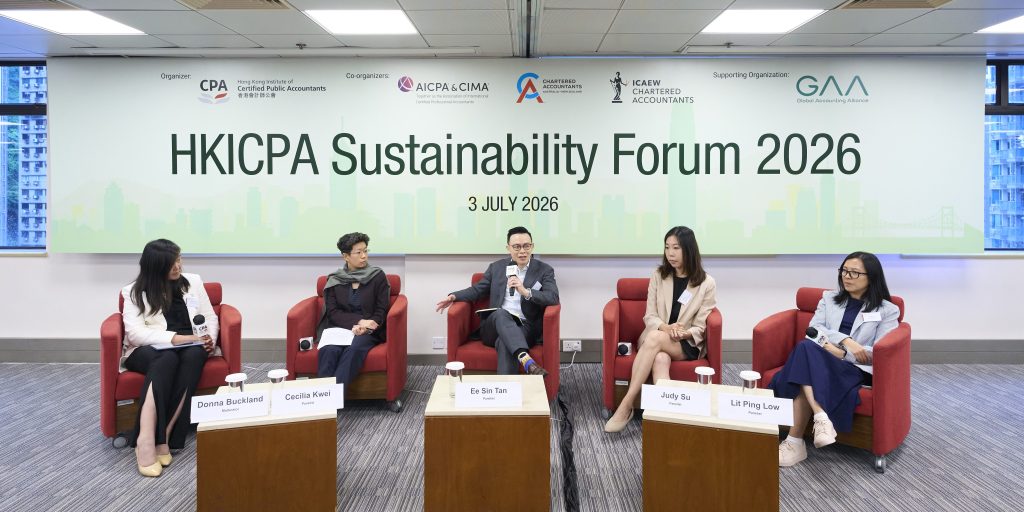
On 3 July, the Hong Kong Institute of CPAs hosted its Sustainability Forum 2026, bringing together regulators, companies and advisors take stock of Hong Kong’s fast-evolving sustainability reporting and assurance landscape. The event was co-organized with fellow Global Accounting Alliance members AICPA & CIMA, CAANZ, and ICAEW.
In his opening remarks, Institute President Stephen Law observed that sustainability reporting has moved from an emerging topic to a core pillar of corporate reporting and capital markets, with investors and regulators now expecting information that is transparent, comparable and decision-useful. He noted that sustainability assurance is becoming an equally critical part of the equation, as confidence in the reliability of disclosures underpins trust in capital markets.
He also shared a significant milestone: the Institute has been officially appointed by the IFRS Foundation as an International Sustainability Standards Board (ISSB) Training Partner which demonstrated the Institute’s commitment and capabilities in sustainability. The appointment allows the Institute to deliver training using official ISSB-developed materials and will inform an enhanced Sustainability Reporting Certificate Programme that blends international content with practical local application.
Navigating emerging disclosure
The first panel focused on sustainability reporting. Speakers noted that the ISSB has completed targeted amendments to IFRS S2 covering greenhouse gas emissions disclosures, introducing reliefs such as refining the disclosure requirements of financed emissions to ease implementation. Work also continues on nature-related disclosures – expected to take the form of a practice statement that builds on TNFD materials and provides voluntary guidance for companies – alongside ongoing projects on human capital and enhancements to the SASB Standards.
Panellists explained that HKFRS S1 and S2 bring a stronger financial materiality lens than many of the existing frameworks, requiring closer alignment between sustainability and financial reporting boundaries and a shift towards more quantitative, decision-useful disclosure. Early adopters were said to benefit from a common international baseline that reduces duplication across markets. Investors, meanwhile, are said to prioritize credible, data-backed disclosures – particularly on Scope 3 emissions, science-based decarbonization targets and climate risk resilience – over the mere existence of an ESG report.
The panel also discussed Hong Kong’s role as a “super-connector”, with the city’s sustainability reporting framework, fully aligned with ISSB Standards, helping companies to produce consistent and comparable disclosures for better access to international capital markets. This is reinforced by the IFRS Foundation’s passporting arrangement, which sees companies using ISSB-aligned standards having their reports accepted in other participating jurisdictions. Speakers agreed that closer integration between finance and sustainability functions is essential, and that the most valuable reports are those that use the standards to tell a company’s own strategic story rather than treat them as a compliance checklist.
Assurance readiness, challenges and impact
The second panel turned to sustainability assurance. Speakers reported that the Accounting and Financial Reporting Council’s consultation on a proposed assurance regulatory framework, which closed in March, drew broad support, with most feedback focused on implementation rather than underlying principles. Capacity building, spanning assurance providers, preparers, investors and users of sustainability information, emerged as a key theme, with stakeholders highlighting the importance of developing a common understanding of limited and reasonable assurance, as well as the role of assurance reports in supporting decision-making.
Companies that voluntarily adopted assurance ahead of mandatory requirements were said to view assurance as more than compliance. Benefits gained from moving early include stronger data governance, improved stakeholder confidence, and better access to sustainability-linked financing. Panellists noted that sustainability assurance differs from financial audits mainly in its reliance on multidisciplinary expertise and its focus on completeness. This presents the challenge of assessing whether all relevant information has been identified and reported, reducing the risk of omissions or greenwashing.
The challenge for many companies is that sustainability data often lives in disconnected, siloed departments using different systems and methodologies. The speakers expect organizations to strengthen their internal processes to improve both data quality and assurance readiness.
They also agreed that effective sustainability reporting and assurance depends on collaboration between accountants and technical specialists such as engineers and environmental scientists. It was also noted that sustainability reporting and assurance have already been incorporated into the Qualification Programme, positioning CPAs to play a central role as sustainability reporting develops.
Together, the two panels underscored that Hong Kong’s sustainability reporting and assurance ecosystem is maturing quickly, and organizations that start early, embed strong governance and treat disclosure as a strategic exercise, rather than a box-ticking one, will be able to build lasting stakeholder trust. With its new status as an ISSB Training Partner, the Institute is set to play a pivotal role in equipping the profession for this next chapter of reporting.