










Jimmy Yip, Chairman of the Institute’s Small and Medium Practices Committee, and Managing Director at Forvis Mazars
Digital transformation is no longer optional – it has become a strategic imperative for accounting firms of all sizes, including small and medium practices (SMPs). However, in Hong Kong, many SMPs continue to face two persistent obstacles: skills gaps and resistance to change. These challenges can slow adoption and prevent firms from realizing the full value that technology offers.
Surprisingly, the most significant capability gap may not be technical competence, but awareness. Many SMPs are simply not familiar with the range of digital tools available in the market or how these solutions can enhance efficiency, accuracy, client experience, and regulatory compliance. Without an understanding of what is possible, firms often struggle to begin planning their digital transformation roadmap.
Raising awareness must therefore be the first step. Forums, peer sharing sessions, case studies, and vendor-led demonstrations all play a crucial role. The more SMPs see real, practical examples of how others have benefited, the easier it becomes for them to practically design and plan their own digital roadmap.
“The most significant capability gap may not be technical competence, but awareness.”
Resistance to digital transformation does not come from unwillingness, it often stems from practical concerns. For example, SMPs operate with limited financial resources, and technology investment decisions must be justified by measurable returns. There could also be resource constraints. Implementation requires time, planning, data migration, and training, and SMPs lack dedicated staff to lead such projects. In smaller practices, frequent staff turnover creates a constant need for retraining, making firms hesitant to commit to new systems that require ongoing user education.
These challenges create hesitation, even when the long-term advantages of digital tools such as automation, improved client experience and enhanced compliance are well recognized. It is recommended that firms adopt a pragmatic and phased approach to capability building:
- Develop “Super users”: Identify a small group of staff to explore tools in depth and act as internal champions. These individuals help maintain continuity, provide training, and support colleagues by addressing day‑to‑day questions as they arise.
- Pilot before full rollout: Testing with a small, representative group helps surface challenges early and refine processes before firm-wide implementation. This can also enhance confidence to the whole team when the tool is fully rolled out.
- Adopt gradually and strategically: Incremental steps help reduce disruption, allowing staff to adapt at a comfortable pace and build confidence along the way.
Ultimately, digital transformation is a people project. Institute members are encouraged to share their experiences, challenges, and best practices in capability building. By learning from one another, SMPs can collectively overcome resistance, bridge skills gaps, and ensure that digital transformation becomes an opportunity for growth rather than an obstacle.

Jason Yau, Partner and Head of Technology, RSM Hong Kong, and an Institute member
As someone involved in both IT advisory and internal IT management, I’ve found that people-related barriers often matter more than the specific technology firms choose.
Global surveys across the accounting profession point to a clear capability gap rather than a lack of awareness. In one ACCA study, 63 percent of respondents felt they had sufficient digital skills to perform their role, but a sizeable minority either lack confidence or were unsure about their capabilities. IFAC’s Global SMP Survey also found that hybrid talent remains a major concern with 54 percent of SMPs struggling to attract next-generation talent and 66 percent of those pointing to a lack of candidates with the right mix of technology and technical accounting skills.
Across different jurisdictions, including Hong Kong, similar themes emerge: staff training requires non-billable investments, high turnover increases the cost of upskilling, and underestimation of the change management efforts. This combination of perceived skills gaps, limited formal training, and difficulty of securing digitally savvy talent contributes to a persistent implementation gap between digital vision and actual return on investments.
Human factors like resistance to change are just as critical. Change is uncomfortable, and hesitation to change can reduce competitiveness or squeeze margins when other firms move faster. Cultural resistance, fear of job loss, and organizational inertia remain key obstacles, especially in firms with long‑established workflows.
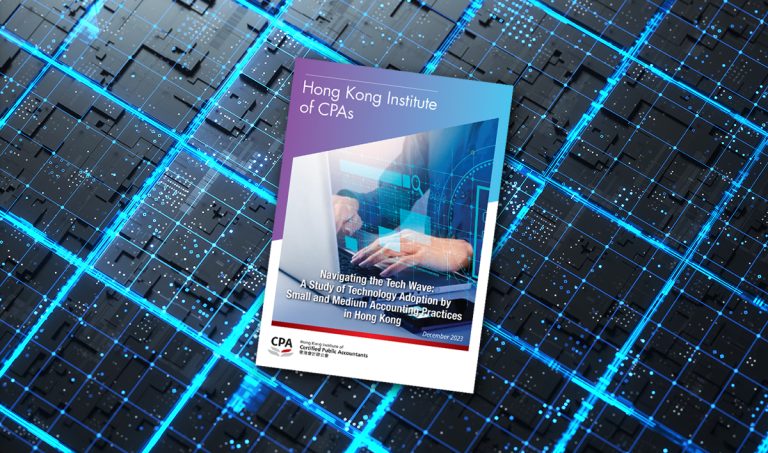
“The HKICPA’s new Digital Transformation Roadmap offers a structured, step‑by-step framework tailored for Hong Kong SMPs and SMEs.”
As much as most cloud-based technology are already affordable and proven, the real risk is under‑utilization of the technology. Without the right mindset and skills, firms end up with “shelfware” systems, inconsistent adoption, and manual workarounds (aka Excel spreadsheet) that quietly erode the expected returns.
The HKICPA’s new Digital Transformation Roadmap offers a structured, step‑by-step framework tailored for Hong Kong SMPs and SMEs. It provides a practical way to assess digital maturity, plan initiatives, and benchmark progress against fellow peers. The Digital Transformation Hub also serves as an ongoing resource base – packed with tools, case studies, and events – helping SMPs stay connected and supported as they proceed on their digital journey.
Hiring digital experts alone rarely solves the capability problem, especially for SMPs with tight budgets and limited local talent pools. Leadership commitment, clear communication, and a supportive culture are often bigger success drivers than the specific technology selected. Long‑term digital capability building requires vision and strong leadership as digital upskilling at a firm level should be embedded in the three to five years plan.

Andrew Yung, Director of IT and Business Advisory Services, APEC Group at Hatcher Group, and an Institute member
Strategy without talent is merely a hallucination – a lesson hard-won across decades in the accounting profession, and one that rings true across every industry today. The traditional accountant’s role as a retrospective recorder of financial history is becoming obsolete. To survive in modern business, accountants must evolve into something far more ambitious: prospective architects of digital strategy.
The significance of the skills gap and resistance to change touches upon the central nervous system of the modern firm. The answer is not a binary choice between technical skills or culture; rather, it is a dual crisis where the shortage of capability fuels anxiety, and cultural rigidity prevents the acquisition of those very capabilities. Research indicates that 70 percent of digital transformation initiatives fail, with cultural resistance consistently cited as the leading factor. For Hong Kong’s accounting profession, acting as a superconnector in the Greater Bay Area, the failure to address this will not merely result in operational inefficiency but in obsolescence.
The significance of the skills gap is often misunderstood. It is a qualitative experience gap and not simply a shortage of bodies. As automation handles the entry-level work that traditionally trained juniors, we face a missing middle in the workforce demographic. Simultaneously, resistance manifests through competency anxiety, where senior leaders fear their hard-earned expertise is being devalued by “black box” algorithms they do not fully trust.
“When an accountant creates a workflow to automate a task they despise, the psychological dynamic shifts from resistance to agency.”
The best approach to addressing these twin challenges is to democratize technology through the “citizen developer” model. Rather than relying solely on overwhelmed IT departments, firms must empower their accountants to build their own business workflow using Low-Code/No-Code (vibe-coding) platforms. When an accountant creates a workflow to automate a task they despise, the psychological dynamic shifts from resistance to agency. This ownership neutralizes the feeling that technology is a burden imposed from above, effectively solving the resistance problem by making the accountant the architect of their own efficiency.
Regarding training and capability building, we must pivot toward experiential learning. This includes internal “hackathons” where cross-functional teams solve specific business problems in real-time, gamifying the learning process and breaking down silos. Furthermore, firms should implement reverse mentoring, where digital-native juniors mentor senior partners on technological trends, bridging the generational divide. The goal is to cultivate “T-shaped” professionals who combine deep technical accounting knowledge with the horizontal skills of data visualization and technological fluency.