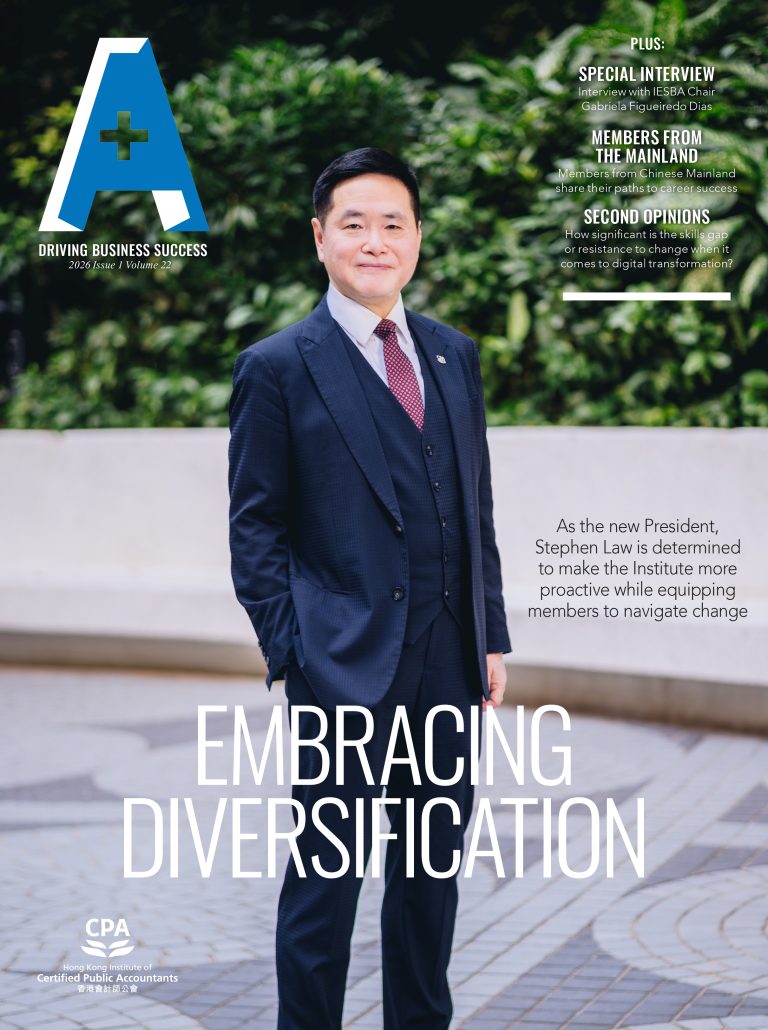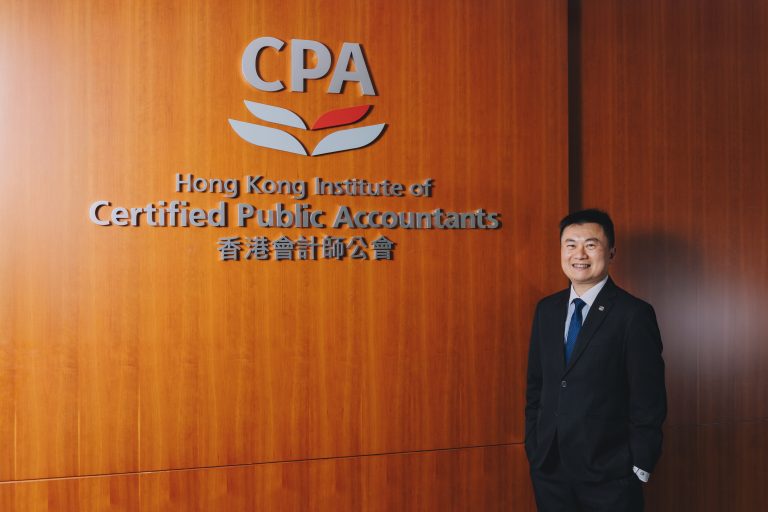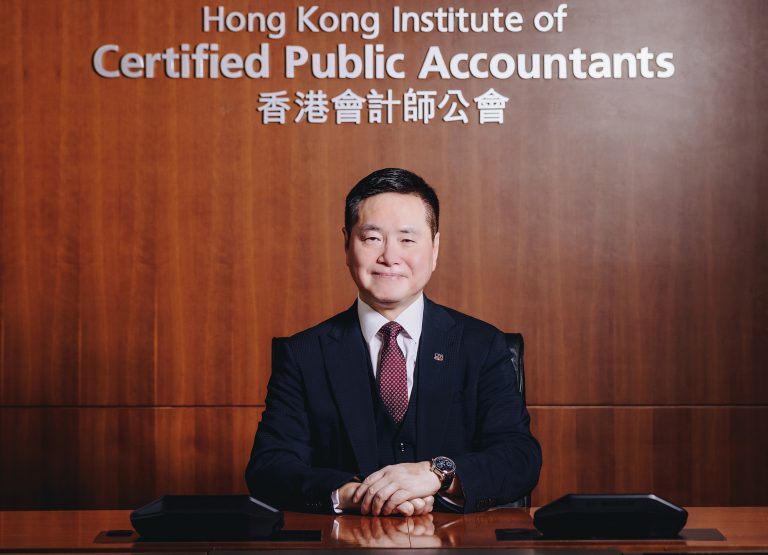








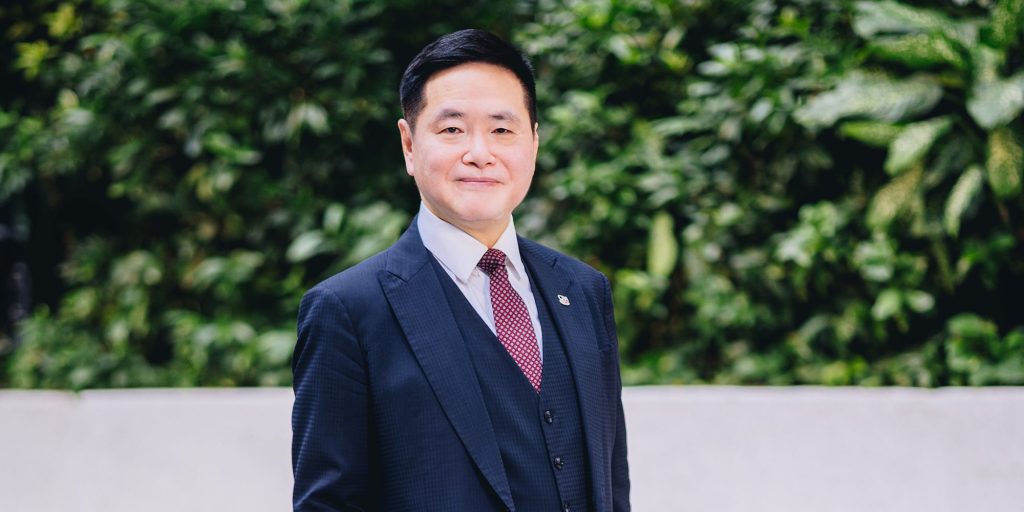
Following the devastating Tai Po fire incident, Stephen Law found himself deeply moved by the accounting profession. In addition to a HK$100,000 donation through the HKICPA Charitable Trust and outreach to affected members, more than 700 members registered as volunteers within a week of the Hong Kong Institute of CPAs sending out a recruitment email. “It was so unexpected. We got so many members interested in helping those in need, and they signed up within days,” says Law, the new Institute President, before revealing a fresh initiative. “We’re going to turn this passion into something permanent.”
This year, the Institute will launch the “HKICPA Volunteer Team” to deliver various forms of volunteering work, says Law. The idea is to not only do good for society, but also serve Institute members in a meaningful new way. “I believe each one of our members is kind-hearted and want to help others, but they are also busy. That’s why the Institute has to take a lead, to remind people that you can do this outside your working hours and contribute to society,” says Law.
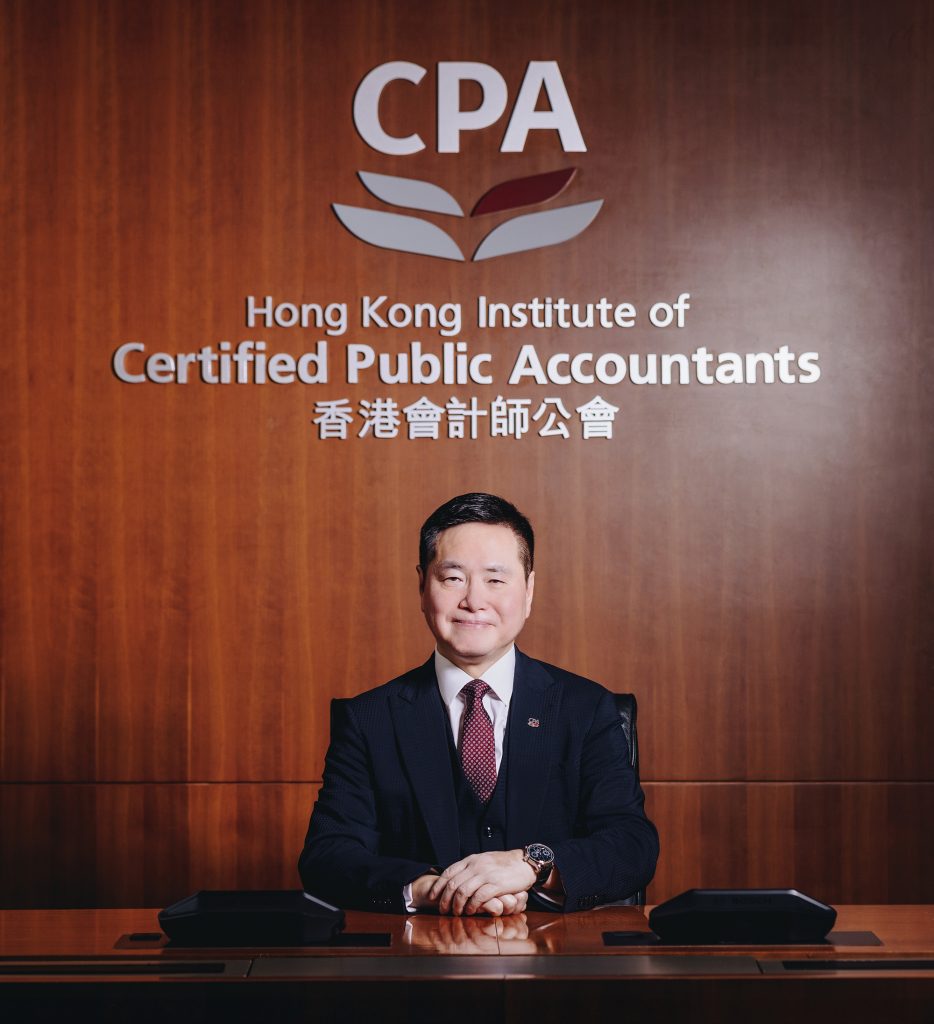
Building on this commitment to member wellbeing, the Institute also launched the Member Assistance Programme, providing members and students with 24/7 telephone counselling among other resources.
As the first professional accountant in business to lead the Institute in over a decade – and its first president who serves as a National Committee member of the Chinese People’s Political Consultative Conference (CPPCC) – Law brings extensive experience from private equity deals, IPO negotiations, and leadership roles at several companies, to transform how the Institute serves its members. He plans to draw from these varied roles to make the Institute more responsive amid Hong Kong’s evolving economic landscape. “We want to be more proactive to serve our members better, in terms of technical resources and support, like digital asset guidelines, and in terms of member services,” he explains.
Positioning Hong Kong for the future
Law’s private equity background gives him fluency in emerging technologies. As Managing Director of ZhongYi Investment Managers Limited, his focus is on investing in “only the new things,” including digital assets. He breaks down digital assets into five categories: cryptocurrencies led by Bitcoin, which he describes as “digital gold”; real world assets as tokenized securities; utility tokens currently without regulatory oversight; stablecoins as payment alternatives; and central bank digital currencies, such as China’s digital RMB or e-CNY.
Following Hong Kong’s stablecoin legislation having taken effect on 1 August 2025, Law expects that three to five licenses will be issued in the first half of 2026. “After the stablecoin there are only two things Hong Kong requires to complete the ecosystem: custodian services and over-the-counter exchanges for general public. After issuing those two licenses, we will more or less have a complete picture. Hong Kong is on course to becoming a bonafide digital asset hub.”
Members will need to navigate this complexity, he stresses. “A lot of our members are not sure how to do accounting for digital assets,” he says. “Eventually there will be more companies using some type of stablecoins for transactions, and our members will need to know how to book those transactions and know the risks of those transactions.”
In January, the Institute issued guidance on which HKFRS Accounting Standards apply to cryptocurrencies and stablecoins. There are also two upcoming resources: one for auditors’ independent attestations on licensed stablecoin issuers, and another for auditors of digital asset-related businesses, addressing common challenges and incorporating relevant guidance from overseas accounting and auditing bodies.
A new flagship training programme on artificial intelligence (AI), data analytics, cybersecurity, ESG tech and emerging technologies will also be launched this year by the Institute, as well as the second phase of the Institute’s Digital Transformation Roadmap, including a hub with case studies. Law emphasizes that digital transformation is no longer an option. “We are helping our members to do transformation, especially small and medium enterprises and practices (SMEs and SMPs). Everyone is using AI, so we will help guide them on this and introduce tools that they can use for transformation,” he says.
Advancing sustainability
As the sustainability disclosure standard setter of Hong Kong, contributing to the development of the city’s sustainability disclosure ecosystem is still a core mission. This year, the Institute will prioritize capacity building, and this includes promoting the HKICPA Certificate on Sustainability Reporting to ESG practitioners. The certificate was designed to empower professionals and companies with essential knowledge and skills for implementing HKFRS S1 and S2.
“We are doing training courses for more professionals in this field so that Hong Kong can be at the top in terms of sustainability, ESG, and also sustainability
assurance.”
“We are doing training courses for more professionals in this field so that Hong Kong can be at the top in terms of sustainability, ESG, and also sustainability assurance. Our Sustainability Disclosure Standards will be adopted first by listed companies, and then by other industry players in Hong Kong. So we will hopefully be at the top of the world ranking for green finance,” says Law.
This year, the Institute will issue HKFRS S2 amendments to reflect changes to greenhouse gas emissions disclosure requirements in IFRS S2 Climate-related Disclosures. These amendments respond to application challenges and will be released upon completion of the Institute’s due process. “We recently reached out to more than 200 listed companies and industry associations to gather feedback on the International Sustainability Standards Board’s proposed revisions to SASB Standards for high-emitting industries. Our aim is to ensure that industry-specific disclosures remain both practical and decision-useful,” notes Law.
At the end of 2025, the Institute welcomed the Accounting and Financial Reporting Council’s public consultation on the proposed regulatory framework for sustainability assurance in Hong Kong. In the press release, Law stated that the Institute “stands ready to contribute its professional expertise to support the development of a robust, credible and internationally consistent sustainability assurance framework, supporting Hong Kong’s transition towards a more sustainable and resilient economy.”
Strengthening the talent pipeline
In the profession’s ongoing fight to attract and retain talent, Law views the Qualification Programme (QP) as crucial. He says the Institute will continue focusing on promoting the QP as the best choice for students who seek to stand out in their future careers. “We will reach out to young people and attract them with a message: You don’t have to be an accountant forever, but it is certainly a powerful foundation wherever your ambitions take you. If you want to go into business or finance, the QP really is the best qualification,” he says.
Law highlights the Institute’s Certificate in Accounting and Business (CAB) as an initiative designed to make the profession more attractive and accessible. Launched last year, CAB offers students with diverse backgrounds, including nonfinancial professionals and aspiring entrepreneurs, a flexible pathway towards becoming CPAs. After completing the CAB, students could continue through the QP.
It emphasizes competences that are highly valued across different sectors, he adds. “When running a business, you need financial knowledge. You need to understand what is behind financial statements,” Law says. “This certificate can show employers that you have sufficient knowledge to run a business. And this is going to be a key focus for us to promote, the CAB in addition to our normal QP.”
Building adaptive professionals
For the next generation of accountants, Law stresses versatility and global awareness. “Of course, you need to understand the accounting basics. But beyond that, you must have an interest in your own industry, and in new developments around the world, including the United States and Chinese Mainland– the global superpowers. If they catch a cold, we will, at the very least, feel the fever rising. So we need to observe those two superpowers closely,” says Law.
The Institute launched a Public Affairs Series last year to broaden members’ perspectives. “We bring in regulators and well-known people to talk about what is happening in the world including in the Chinese Mainland,” Law explains. “For example, how China’s five-year plan will affect Hong Kong.”
This global outlook serves the Institute’s ambition to promote Hong Kong internationally. “We intend to organize more overseas trips for Council members, and we want to showcase two things: Hong Kong is an international financial centre, and accountants play a vital role in this. Whether you come here to set up a small business or large business, or for tax advice, or for an IPO for fundraising, accountants play a major part,” says Law.
A key focus this year is to promote the unique advantages of Hong Kong’s accounting services to Mainland enterprises through its “List of accounting firms helping Mainland enterprises go global,” a resource that aims to connect Chinese Mainland enterprises with the right accounting firms to support Chinese companies in their overseas expansion. As of end-2025, the list included 87 Hong Kong firms.
“It’s not just accounting firms – all accountants play a major role in Mainland companies going overseas,” Law says. “Whenever there’s a transaction, a finance person is always involved. From calculating the investment return to fundraising, to understanding the overseas tax laws and regulations, all this work from start to finish is done by the accountant.”
Law raised another example of a longer-term initiative focused on establishing professional support for valuation work. “Valuation requires professional judgement and many accountants are already engaged in this work,” he notes. “We want to study this specialization with the ultimate aim of fostering innovation and creating meaningful opportunities for members to lead and excel in valuation in the years ahead.”
He is also keen on enhancing membership perks by leveraging the Institute’s scale. “We have 48,000 members, which is sizable enough for us to attract commercial organizations to work with us, and to get discounts,” he says.
Reshaping business models
Law’s journey began with a degree in civil engineering, but he was drawn to accounting and the idea of keeping doors open. “Something I always say is, if you’re an engineer, you will always do engineering. If you’re a lawyer, you will always do legal work. But as an accountant, you have a diversifying career ahead of you,” says Law.
He emphasizes this versatility as a key selling point for the profession. “Even in CPA firms, you could do tax, consultancy, and outside CPA firms, you could do accounting, corporate finance, investment banking, be a CEO, or investing like me,” he says.
His career path ended up representing the diversification he champions. After starting at a Big Four firm in the United Kingdom and Hong Kong, he sought more impactful roles. “I was looking for opportunities to apply my skills beyond auditing, and create impact in new areas,” he explains.
A turning point came two years after he joined Hong Kong-based property group Wheelock and Company in 1995 to work in investment controls. “We started to partner up with international companies and formed joint ventures, then brought them to Hong Kong, the Mainland, and other Asian countries, so that we could diversify,” says Law. “I went from back-end to front-end: negotiations, setting up new entities, and also adding value to the entities, so that the business could improve.”
“Whether you come here to set up a small business or large business, or for tax advice, or for an IPO for fundraising, accountants play a major part.”
In 1997, Wheelock transferred Law to Wharf Cable (now i-cable), where he recognized untapped potential in its extensive but underutilized fibre network. “I conducted a business study to enhance the network so that it could become two-way interactive,” he recalls, enabling the company to launch broadband internet and voice‑over‑IP services just as the early internet era accelerated in 1999. This resulted in a dual-listing on Nasdaq and the Hong Kong Stock Exchange.
Law notes that the experience taught him the full arc of corporate finance, “from a business model to the listing, and then post‑listing, working with research analysts.”
After this successful stint, Law became a director of Morningside Ventures, focusing on achieving attractive returns for investors in their venture capital investments. He then joined TPG, one of the world’s largest private equity firms. As a managing director, he was responsible for private equity investments in Asia and led key deals across different industries, securing many IPOs and subsequent exits in Hong Kong, the U.S. and Vietnam.
Law likens the process of mergers and acquisitions to courtship, where a target may have multiple suitors at the same time. “The challenge,” he says, “lies in convincing the company to choose you: demonstrating how serious you are, getting to know each other better, and showing why your partnership creates the strongest future.”
He often recounts the “war stories” that shaped him as an investor: deals worth billions that looked doomed but somehow prevailed at the eleventh hour, and others that seemed like sure wins until they crumbled right at the buzzer – and everything in between. “Those situations teach you humility,” Law says. “I always tell my juniors: don’t get complacent when you think you’re at the peak, but don’t lose heart when things look tough.”
He notes that navigating these ups and downs sharpened his instincts for solving problems under pressure, negotiating complex deals, and navigating the human dynamics that shape every deal. Law also credits his successful investment track record to his CPA training. “I lean on the full spectrum of my CPA background – from structured analysis to sound governance, strategic thinking, and a deep understanding of how businesses create value, all of it,” he says. “CPAs have all the ingredients to add real strategic value.”
Law’s four years at MTR provided perhaps his most valuable education in navigating complexity. At the time, MTR’s High-Speed Rail project was met with budget overruns, with discussions centred on which party should bear the increased costs. “This is how I came to understand the Hong Kong political environment,” he explains. These experiences shaped his understanding of public expectations – perspectives that now inform his approach as President of the Institute, helping guide how the profession and the Institute contribute to broader trust and confidence in business and society.
Today, in addition to being a member of the National Committee of the CPPCC, Law is a Ministry of Finance-appointed Hong Kong accounting advisor. He was also appointed as a Justice of the Peace for Hong Kong on 27 July 2022.
Diverse interests
Like his career, Law’s interests are multifaceted. His board positions at Cyberport and XtalPi, a company using AI, quantum physics, and automation for drug discovery, are opportunities to stay current with technology. He is also a proud board member at the Hong Kong Dance Company. “Now that I’m older, I’ve become more interested in the arts.”
Interacting with different groups of people, he notes, is something he both enjoys and finds professionally valuable. “You learn a lot from meeting and talking to different people. I have often found the people we meet in our personal lives can become valuable partners in our professional lives, and vice versa. For me, work and life are intertwined,” he says.
Law now wants to execute plans that can help members be diverse in their knowledge, believing this to be the best approach for navigating the quick-changing environment, and reinforcing Hong Kong’s role as a leading international financial centre. “I’ve got a lot of dreams,” he laughs. “Life is not straightforward these days. So I think being diverse is going to be essential, more essential than ever before.”
Talent attraction and retention is one of the Institute’s key work focuses for this year. In 2025, the Institute reached over 60 faculties of universities, organized 60 QP talks (reaching around 4,300 students) and nine career workshops. In Chinese Mainland, it organized 26 QP talks across accredited or the Institute’s New Partnership Scheme universities.